Tuition & Education
AIM: LOWERING THRESHOLDS TO THE CREATIVE INDUSTRIES
In the longer term, pairing up talented young people with representatives of the creative industries will increase diversity in business.
There is a large gap between those whose parents completed post-secondary education and young people who come from homes where the parents did not access higher education. As examples of this, Sabinor Haas Lönnroth, Executive Director of F1RST, mentions two geographical areas of Stockholm.
“In Vasastan 75 percent have an academic background, but if you take the metro to Järva that percentage falls to 24 percent. That’s a huge drop, and what you lose is the career paths that young people see ahead of them and the step into higher education,” she says.
F1RST was established in 2023 by the Daniel Sachs Foundation and the Stockholm School of Economics, and its goal is for young people from households without a university background or from underrepresented groups to take the step into higher education and choose non-traditional study paths.
Last autumn F1RST received its largest donation to date: SEK 6 million from the Erling-Persson Foundation. At H&M Group, which is joining the initiative as a knowledge partner, Åsa Agebäck is Chief HR Officer.
“The Foundation is opening up an opportunity for us to contribute and make a difference in matters that are important for society, and at the same time come into contact with future talents. When we heard about F1RST, which is passionate about making a difference for young people from different backgrounds, it felt good to be a part of and support that work,” she says.
Ethel Ghirmai, Global Head of Employer Branding at H&M Group, adds:
“It’s an excellent opportunity to establish a relationship early on. Lots of young people are about to enter the job market, so we can show them that there are more roles with us apart from working in a store and that our global presence offers many career opportunities. We can show who we are as an employer and demonstrate our culture.”
F1RST was a spin-off from the financial sector and this collaboration opens up new opportunities.
“We know that the creative sector has been inaccessible, mainly due to the lack of role models that give young people the courage to take the leap: ‘If she can do it and she looks like me, then so can I’. There’s also a lack of open doors – they don’t know how to get in,” says Sabinor Haas Lönnroth, continuing:
“We’re also keen to find out more about H&M Group’s many female leaders. Our female students at Stockholm School of Economics and Stockholm University thought it sounded inspiring and wanted to get a conversation going.”
“Young people often tend to choose professions that they are already familiar with through parents or others.”
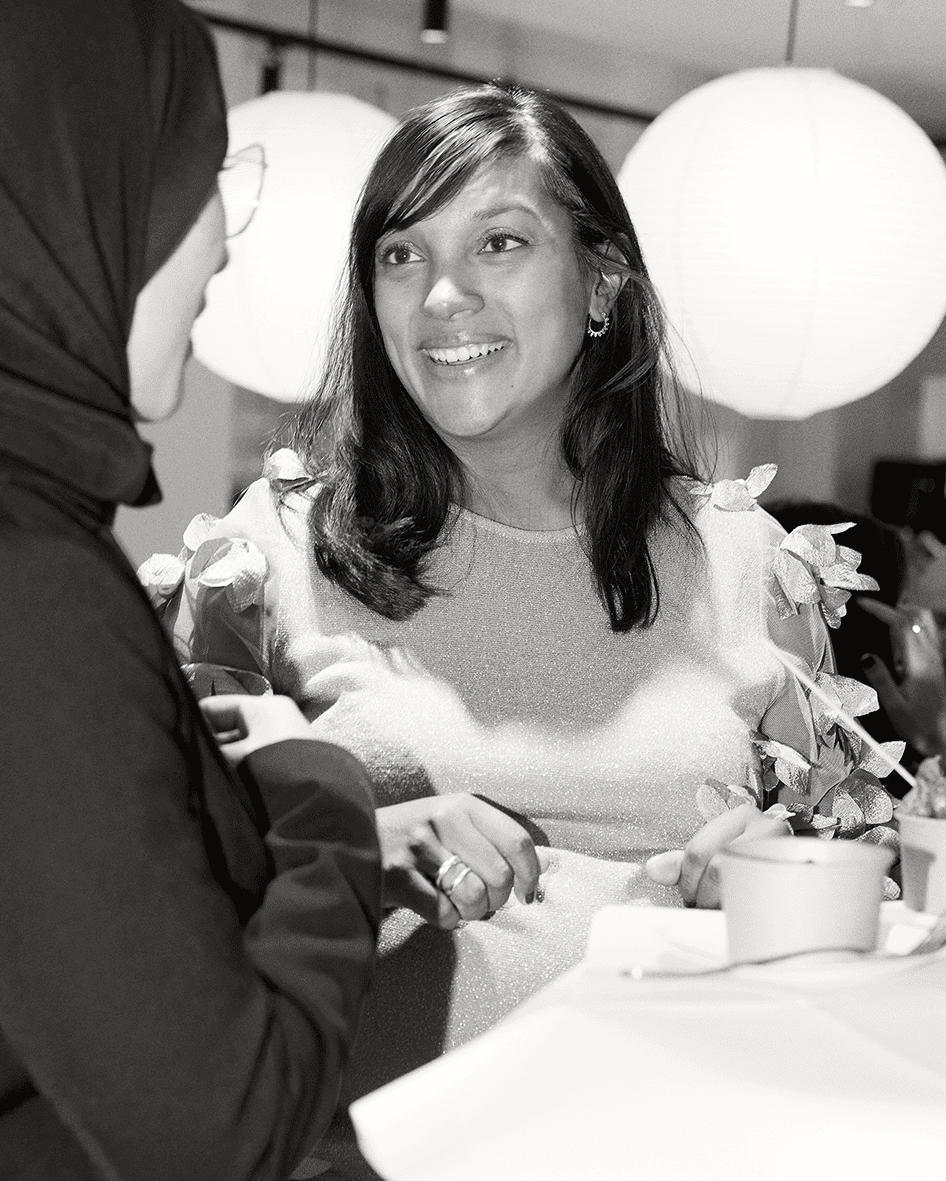
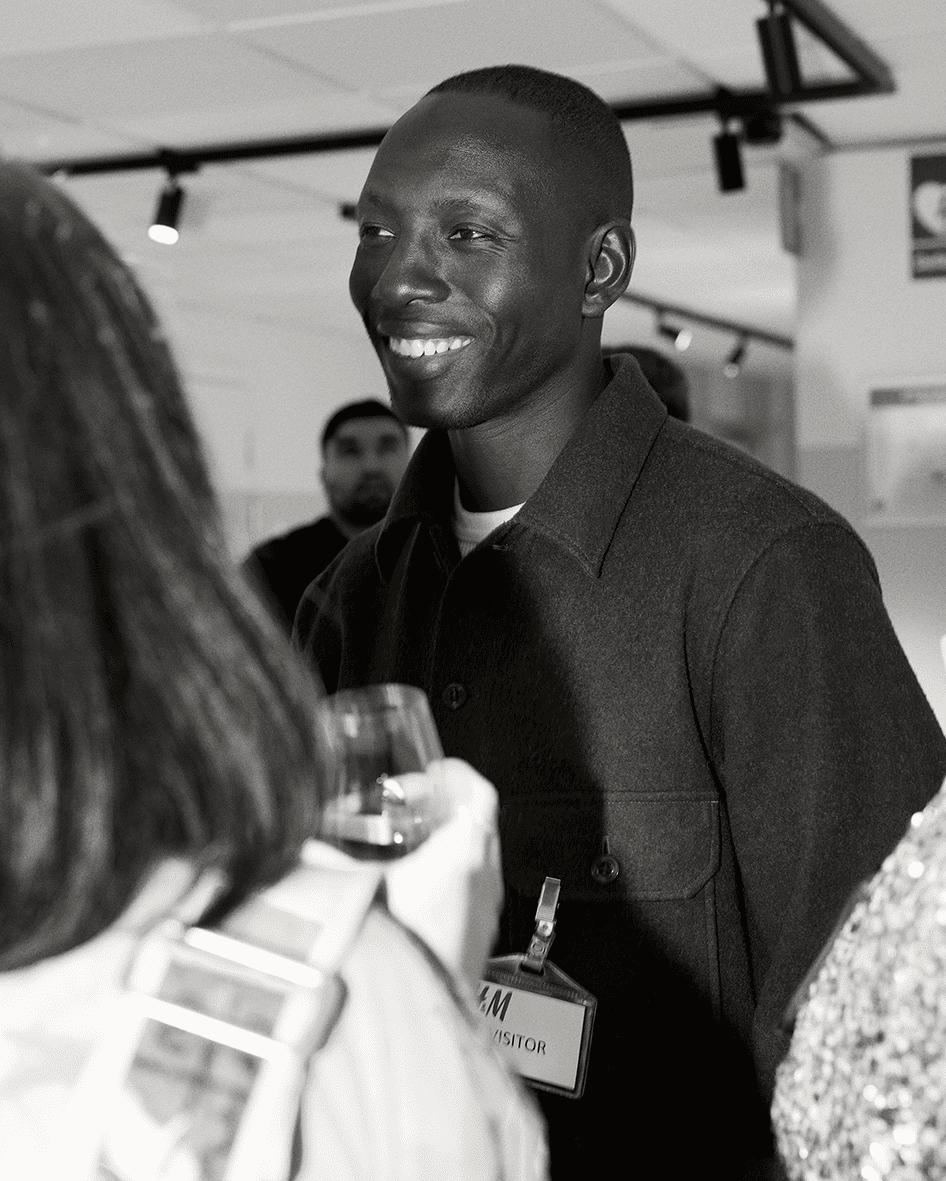
At the beginning of November 2024 F1RST and H&M Group held a kick-off event in the atrium at the company’s headquarters in Stockholm city centre. This brought together around 20 members of F1RST and just as many business partners from different sectors.
“We talked about H&M Group and the many different opportunities that exist in the company, and many of the young people were surprised – both that we are such a large company with so many nationalities, but also at the diversity in our corporate culture,” says Ethel Ghirmai.
Åsa Agebäck adds:
“I was in contact with several of the young people afterwards. Now that we’ve posted our internships on our website – in other words, our summer jobs – I would think that some of them have applied,” she says.
They also presented the first mentors, one of whom was Karl-Johan Persson, chair of the board at H&M Group.
- 24%
proportion of those from families without an academic background who go on to higher education, compared with eight out of ten from homes with parents who have post-secondary education
- 1/10
proportion of those in the financial sector who represent a background with no history of higher education
- 200
total number of mentors provided within the F1RST network
“As a first step we are offering three mentors, which may not sound much given our scale. But these three mentors and three mentees will then pass on the knowledge to their networks, to their friends and classmates. This is a better quality way to spread information and gives us a better understanding of ourselves as an employer,” says Ethel Ghirmai.
Young people often tend to choose professions that they are already familiar with through parents or others.
“That’s the gap we want to reduce – many don’t even know that you can apply for internships at H&M Group,” says Sabinor Haas Lönnroth. She points out that it is a mutual exchange between F1RST and the companies they partner with.
“We hope these companies will make contact with a target group that can be difficult for them to reach when recruiting. Our members are talented and ambitious young people who do not have their future path set out, but the drive is there. We want the companies to see our talent pool, attract them and hire them in the future – that’s our long-term hope,” she says.
In addition to mentoring and internships, F1RST and H&M Group have discussed job shadowing, work experience and trainee programmes.
“Once you’re a few steps further on, then you give back too and mentor those younger than yourself.”
“Trainees are introduced to the company and get practical insight. I also think this mentoring has helped them understand what a working day looks like – what you do in practice – and that’s not so easy to learn in a classroom,” says Ethel Ghirmai.
Sabinor Haas Lönnroth explains that in the F1RST Connect mentoring programme, university-level participants have mentors from companies and then themselves act as mentors for younger members of F1RST who are at upper secondary school. F1RST offers programmes from around age 14-15 onwards, right through to upper secondary school and university.
“We start at age 14 to 15 because we know that upper secondary is too late if we’re to inspire people to study at a higher level. We partner with schools in socioeconomically disadvantaged areas or where we see a lower proportion of parents with an academic background,” she says.
The school programme for ages 14–16 and for upper secondary level (ages 16–19) is called F1RST Step. Here teachers can nominate talents, but students can also sign up themselves. The programme includes workshops as well as visits to Stockholm School of Economics, KTH Royal Institute of Technology and Stockholm University. The school pupils get to meet students who they can relate to but who are a few steps further on from where they are themselves.
“Once you’ve set foot in a university or college, taking that step is not as scary. Then we have company visits, where they get to listen to and meet people with different roles – we want to make more career paths visible,” says Sabinor Haas Lönnroth.
At university level the aim is to clearly reduce the gap to working life, through contact with businesses.
“Members need to know ‘How do I build my network? How do I land this job? What can I work as once I’ve completed my studies?’” she explains.
Sabinor Haas Lönnroth describes it as an ecosystem.
“Once you’re a few steps further on, then you give back too and mentor those younger than yourself. People who come from a disadvantaged background often have a desire to give back,” she says.
And the efforts are making a difference.
“Some of our young people have changed direction. One example is a student who was studying economics at Stockholm University. Via F1RST, they got in touch with the media company IN/LAB and now they work there.”
The change of course is not always appreciated, however.
“For example, I got a call from a parent who said ‘My son got into Stockholm School of Economics and is going to study economics – throwing away a safe and secure future as a doctor. What have you done?’
“If everyone can find their inner calling and what they’re good at, the effect will be all the greater.”
In that case we take the call and say that the most important thing is for your child to be happy, but also that other study and career paths are not wrong. If everyone can find their inner calling and what they’re good at, the effect will be all the greater,” she says.
Sabinor Haas Lönnroth says this is long-term work.
“If a member aged 14 or 15 attends an event or meets a university student who themselves had a mentor, the effect can come much later. So you need to be patient. We believe that education is the way forward, but we also want to show that there are many options to choose from.”
She points out the importance of their meetings.
“There’s an incredible amount of company information on websites, for example – but our target group needs that conversation, that meeting. As a minority, sometimes people don’t dare to take up space,” she says, continuing:
“I know that Stockholm School of Economics collaborates with H&M Group for the students it takes on its retail management programme, but our events are smaller and have a big focus on inclusion,” she says.
“We believe that education is the way forward, but we also want to show that there are many options to choose from.”
Ethel Ghirmai mentions that generations take in information in different ways.
“In campaigns TikTok may get the majority of the attention, while LinkedIn is not nearly as receptive – it shows where the future generation hangs out,” she says.
Åsa Agebäck fills in:
“The younger generations care about what companies stand for – matters such as their purpose, diversity and sustainability are key. They don’t just want a job, they want the company to represent their values. It’s important for us to live up to our commitments and high goals, and of course we hope these will chime well with the expectations of talented young people. It’s important for us to be a responsible and attractive employer.”
She also emphasises the breadth within H&M Group.
“We have colleagues from many different backgrounds who love working here as we can offer many different roles and perspectives. Lots of people from other backgrounds love working here, because we can offer both in an inspiring way,” she says.
So what does the support from the Erling-Persson Foundation mean? According to Sabinor Haas Lönnroth, there are two elements to it.
“It’s partly financial – it means we can have a larger team. Both so that we can measure effects, but also we’ve hired a project manager to focus exclusively on the age group below upper secondary level, which means we can offer our programmes in a wider geographical area. There can be some mistrust of projects, but we’re in it for the long term and we know that you need to be patient and work with younger age groups,” she says, continuing:
“Getting H&M Group as a knowledge partner has been equally as important. After all, not everyone wants to go into banking or become a consultant – so we can showcase H&M Group as a potential employer with all the different roles that exist in the company.”
Åsa Agebäck highlights the importance of consensus.
“As an employer, one of our core values is ‘we believe in people’. That means we’ve always seen the spark in people’s eyes no matter where they come from, and I feel that our values chime well with F1RST,” she says.
The partnership began last autumn but is already spreading ripples.
“Our next round of the mentoring programme is now open and more people are writing ‘I want to get into the creative industries’. Before it was always consultants, finance and lawyers – so just doing something small can have a clear effect,” says Sabinor Haas Lönnroth.
Om projektet
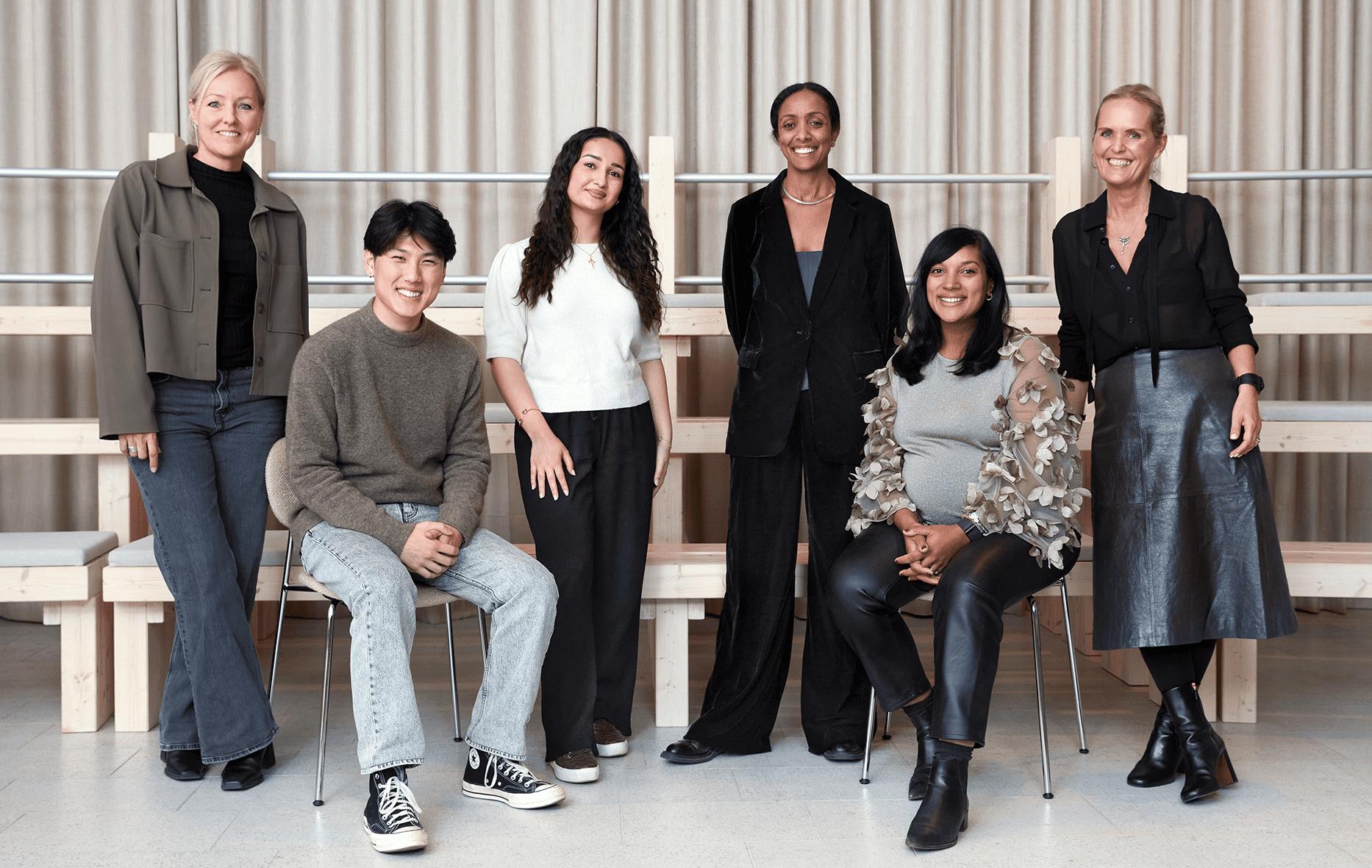
Leads: Sabinor Haas Lönnroth (F1RST), Åsa Agebäck and Ethel Ghirmai (H&M Group).
Title: Future talents – partnership between the Erling-Persson Foundation and F1RST, with H&M Group as knowledge partner.
What it involves: The goal is to shed light on the educational opportunities and professional roles that exist within a creative company, and to bring forward talented young people who might otherwise be difficult for companies to find.
Funding: The Erling-Persson Foundation is supporting the project with SEK 6 million over three years.


