Science & Research
AIMING TO IRRADIATE A FAST-GROWING AND DEADLY CANCER
Today there are good treatments available for many types of cancer, but some variants still have a very poor prognosis. Now Marika Nestor and her colleagues are aiming to attack a particularly aggressive type of cancer with a unique form of targeted radiotherapy.
Advancements in cancer treatments have yielded significant successes over the past thirty years. For many diagnoses, what was once a death sentence has been transformed into a chronic – and sometimes curable – disease. But unfortunately this does not apply to all types of cancer. One particularly malignant form is called anaplastic thyroid cancer, which has a very poor prognosis and is characterised by undifferentiated cells.
Marika Nestor, a professor in biomedical radiation sciences at Uppsala University, has identified a molecule present on the surface of certain cancer cells. By attaching radioactive lutetium to an antibody that recognises this target, it is possible to direct radiotherapy specifically at these cancer cells. The target molecule CD44v6, for example, is present on cancer cells in anaplastic thyroid cancer.
“When I asked around at the local hospital about who was responsible for these patients, I was told ‘there’s no-one specifically in charge of them – they usually pass away before we get that far’, which of course was a terrible thing to hear,” she says.
In the project Clinical translation of antibody-based molecular radiotherapy of advanced thyroid carcinoma the goal is to conduct an initial clinical study. In this she is collaborating with clinicians at Karolinska University Hospital in Solna. Jan Zedenius, a professor of endocrine surgery, is blunt about the situation:
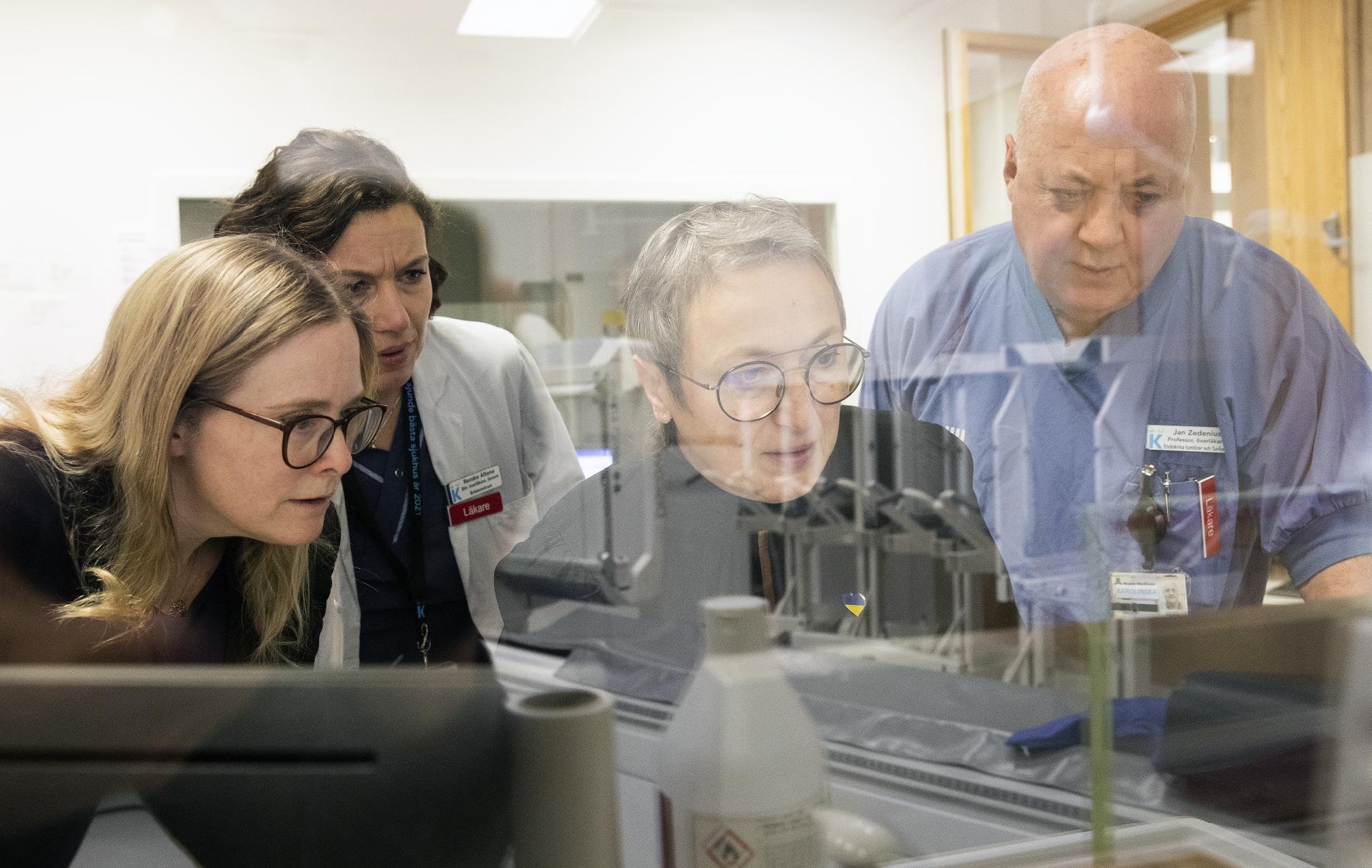
“It’s the worst human cancer. What we can do is surgically remove as much tumour as possible so that the patient gets to die a regular cancer death from their metastases. In cases where surgery isn’t possible, the tumour strangles the patient within three months... I’ve seen tumours grow visibly on the neck between the morning and evening rounds, so we are in desperate need of new treatment,” he says.
Renske Altena, a medical oncologist specialising in breast cancer and researcher at Karolinska Institutet, adds:
“Other types of cancer have a patient association that survivors engage with, but not in this case,” she says.
The team also includes Rimma Axelsson, a professor of nuclear medicine.
“When we want to start studies involving new radiotherapy it’s important to be able to assess the doses absorbed, how the radiation source is distributed in the body and so on,” she says.
Along the way to the clinical trial Marika Nestor has been able to demonstrate good effects in animal experiments. In studies with mice, which had had human tumour cells implanted under the skin, it was observed that the targeted antibody coupled with the radioisotope lutetium 177 not only found the tumour cells, but also killed specifically those cancer cells. In a comparative study it was observed that in mice receiving the active antibody the tumours melted away, while control mice receiving the inactive antibody died. Since then she has withheld her results and not published any articles.
“Not being able to publish is something of a paradox for a researcher. But we knew for sure that we wanted our antibody to be able to be used for treatment, and for that it needed to be patented. Now we have various articles on the way to being published,” says Marika Nestor.
In the upcoming clinical trial the research team will treat patients in two rounds. First, a group of three to six individuals will receive a very low dose. The dose must be low enough that the risk of side effects is negligible, but it must allow imaging technology to track how long the antibody remains in the blood and how well it reaches the patient’s tumour and its metastases.
- 2
2 million target molecules can be present on the surface of a cancer cell. This is many orders of magnitude more than on healthy cells. Researchers have seen good effects in animal experiments even with sparser distribution of around 200,000 target molecules.
- 25–40
The number of people affected by the dreaded anaplastic thyroid cancer each year in Sweden.
- 50%
Half of patients with anaplastic thyroid cancer have a variant with the target molecule CD44v6 on the surface. In the trial all patients are tested, so that only those who have a chance of benefiting from the treatment are included.
“Working with targeted radiotherapy is a great advantage – you can monitor how it progresses over time. It’s also gentler than external radiation, especially if the patient has many metastases,” says Rimma Axelsson.
Safety is paramount, and patients will be closely monitored after the first dose to ensure that the side effects are not serious while slightly higher doses are tested.
In other contexts an increased risk of secondary blood cancer has been observed after radiation.
“But for our patients, it’s conceivable that a one percent or so risk of developing leukaemia after thirty years might be worth taking,” says Marika Nestor.
While it is essential that patients with anaplastic thyroid cancer are able to participate in the trial, there are also openings for other types of cancer provided the cancer cells have the same target molecule on the surface. This applies, for example, to certain forms of lung cancer, variants of head and neck cancer, and some gynaecological cancers such as vulvar cancer.
“The latter group is characterised by a lack of effective treatment options, so these patients have more or less ongoing clinical trials,” says Renske Altena.
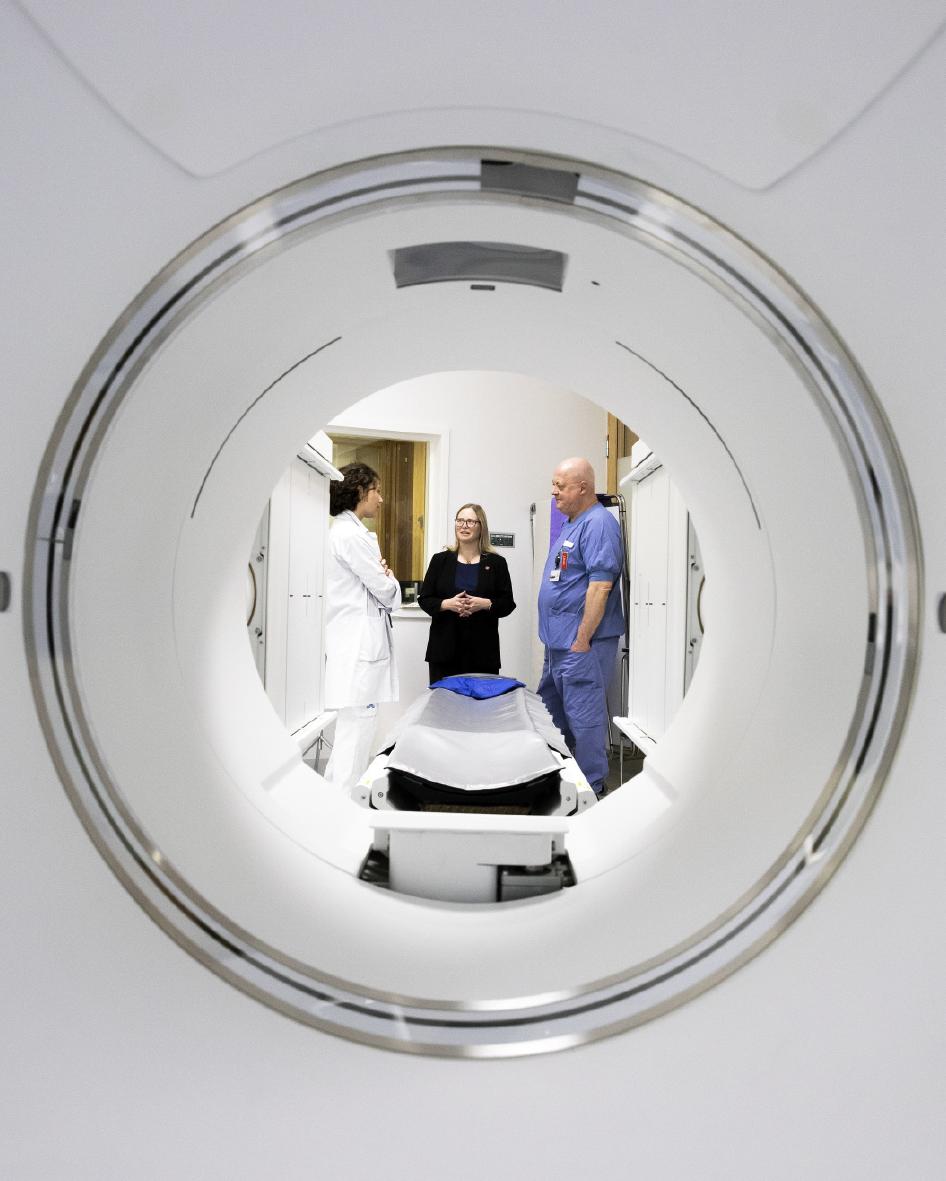
All four emphasise the importance of working as a team, with everyone’s different expertise contributing to the whole. Marika Nestor highlights the role of her clinical colleagues.
“My role is reducing as we hand over more to those who have contact with the patients and can perform the imaging studies,” she says.
The support from the Erling-Persson Foundation is very welcome.
“It makes all the difference! We’ll be able to conduct a good, independent academic study that we design based on our expertise,” she says. Renske Altena continues:
“It gives us an opportunity to evaluate something that could help our patients without having to be limited by commercial interests.”
Rimma Axelsson emphasises that a peer-reviewed grant gives the study a stamp of quality.
“It shows that there are others who believe we are on the right track,” she says.
The research team hopes that in three years’ time they will be ready to plan a larger clinical trial involving more patients. Time will tell whether that is so. But even if the work does not lead to a drug, the trial is still important, believes Jan Zedenius.
“Perhaps targeted radiotherapy can serve as a neoadjuvant, meaning that tumours can be shrunk so that previously untreatable tumours become surgically accessible,” he says.
And Marika Nestor poses a rhetorical question:
“With the fantastic preclinical data that we have – if we’re not going to proceed to a clinical trial now, when will we?”
Om projektet
Project leads: Marika Nestor with Renske Altena, Rimma Axelsson and Jan Zedenius.
Title: Clinical translation of antibody-based molecular radiotherapy of advanced thyroid cancer.
What it involves: A targeted antibody has been attached to the radioisotope lutetium, and with this researchers will treat patients with conditions such as anaplastic thyroid cancer, for which there is currently no effective treatment.
Funding: The Erling-Persson Foundation is supporting the project with SEK 6 million over three years.


