Science & Research
AIM: EFFECTIVE STEM CELL THERAPY FOR PARKINSON'S DISEASE
In Parkinson’s disease, dopamine-producing cells in the brain die off. From stem cells, researchers have been able to cultivate a high proportion of cells that cure the symptoms in animal experiments. In this project they want to grow cells on a clinical scale for future transplant studies involving patients.
More than 20,000 people in Sweden are living with Parkinson’s disease, which affects nearly two percent of the population over the age of 60. The problem today is that the drugs available become less effective over time. An attractive solution is therefore to transplant healthy cells into the brain, where they will be able to produce the dopamine needed.
“Such attempts were made in the 80s and 90s, including in Lund, but at that time cells from aborted embryos were used. Not only is that a complex ethical issue, but it is also difficult to standardise a treatment based on embryonic tissue,” says Johan Ericson, Professor of Developmental Biology at the Department of Cell and Molecular Biology, Karolinska Institutet.
Since the early 2000s researchers have instead focused their attention on human pluripotent stem cells, in the hope that these cells can be converted into the specific cell type they want in a controlled and effective way. But it has turned out not to be quite that simple.
As a developmental biologist, Johan Ericson has spent 30 years understanding how the nervous system and various parts of the brain develop in early embryos.
“While many in the stem cell field have read the research articles we have written over the years, few are actually experienced in the hands-on work involved in guiding stem cells’ path to maturity,” he says.
The project Development of a therapeutically high-effective ATMP product for Parkinson’s disease aims to use a specially developed protocol to direct human stem cells to begin forming the cells needed in transplantation.
The cells wanted are mesencephalic dopaminergic neurons, a variant of the brain’s total of around 10,000 different kinds of nerve cells. Since the desired cells do not survive transplantation once they are fully differentiated, the trick is to develop stem cells into immature precursor cells, which are then expected to develop into functioning dopamine-producing cells after transplantation.
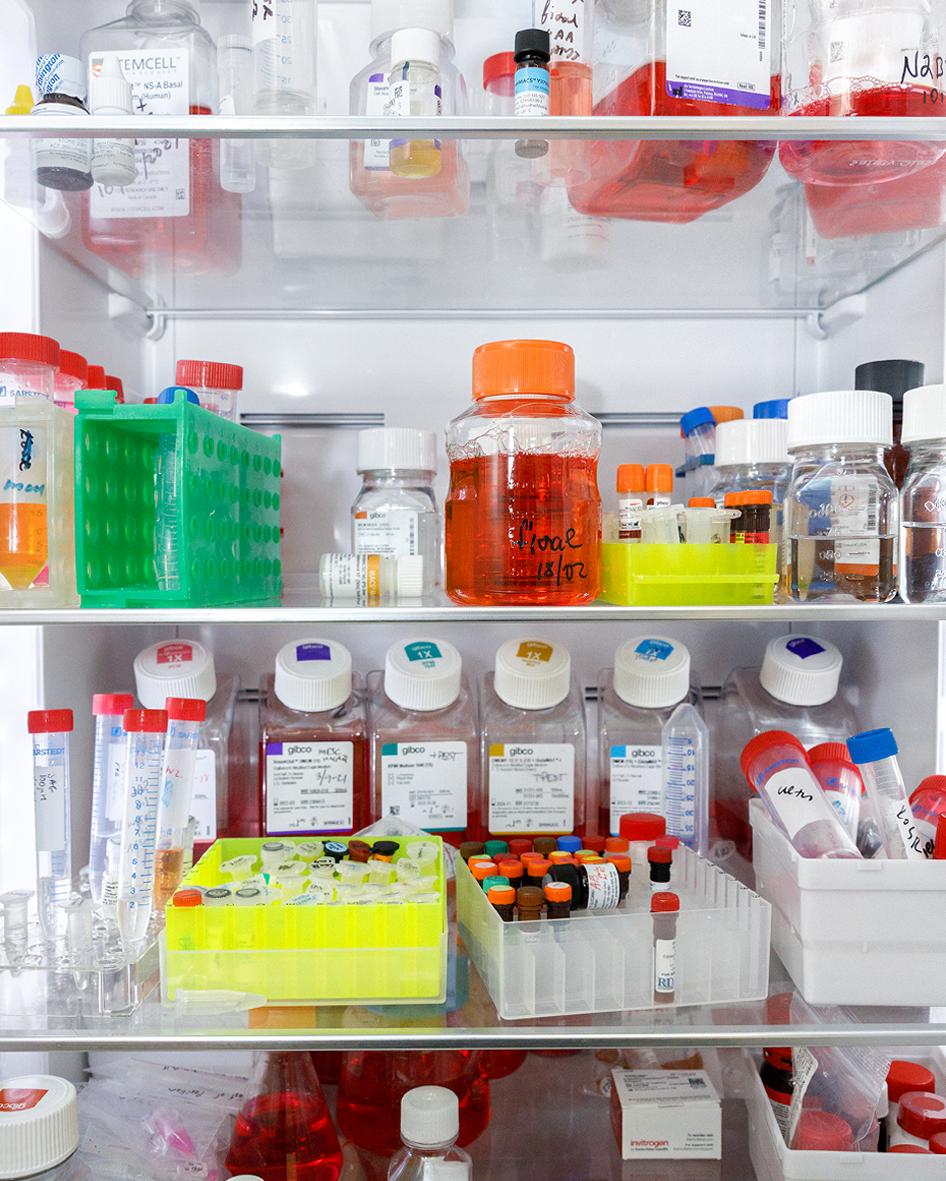
Under the method patented by Johan Ericson and his colleagues, the stem cells must be exposed for a defined period of time to retinoic acid – a signal molecule derived from vitamin A.
“Stimulating the cells for a specific period of time, rather than with a specific dose, is a more reproducible process,” says Johan Ericson.
That retinoic acid can be used to stimulate the development of dopamine-producing cells was published by them in Nature Communications in 2022.
The cells are then bathed in solution containing a small molecule that stimulates the so-called Wnt signalling pathway, to guide development towards the desired cell type. This signalling pathway is the one that other research groups have also relied on.
Johan Ericson and his colleagues are therefore using a combination of signals.
“We believe that our method better mimics the normal development of cells in an embryo, which in turn results in an improved cell product for the treatment of Parkinson’s disease,” says Johan Ericson, adding:
“It may sound simple, but developing our sequential method has taken us three years, plus the time to figure out how we should use retinoic acid.”
“Few are actually experienced in the hands-on work involved in guiding stem cells’ path to maturity.”
By analysing specific cell markers the researchers can see that the yield in the graft ends up at 60 percent mesencephalic dopaminergic cells. This can be compared with other methods that are currently under clinical trial, where the yield is a few percent and the grafts mainly contain unwanted cell types – making the graft volume greater without having any positive effect.
“Our grafts in preclinical animal experiments are one cubic millimetre in size. Those from others can be up to fifteen times larger,” says Johan Ericson.
To investigate how the cells function in the brain, the researchers use rats. The animals are given a controlled injury in one hemisphere of the brain that causes Parkinson-like symptoms in that half of the body. The researchers then try to ‘cure’ these with transplanted nerve cells. When the animals are able to use both halves of the body equally again, their injury is considered to be cured.
“Even though our grafts are small, we cure our rats in half the time – in three months rather than six months. This rapid effect is because most of the transplanted cells develop into dopamine-producing cells, so the grafts contain a very large proportion of therapeutic cells compared to alternative methods,” says Johan Ericson.
Today there are a few clinical studies ongoing that use stem cells developed according to other protocols.
Within the project Johan Ericson and his colleagues now want to cultivate stem cells according to their own protocol but on a much larger scale and demonstrate that the production process is reproducible. When 500,000 stem cells are seeded into culture bottles they should form towards 675 million cells – enough to treat 50 to 100 patients – and the cells must then be frozen in ampoules.
- 1
cubic millimetre is the size of the cell implant that is to be used – 15 times smaller than in other studies
- 60%
the proportion of dopamineproducing cells contained in the grafts in preclinical animal experiments, as compared with yields of a few percent published by other groups
- 3
months is how long it took for rats that had cells transplanted to become symptom-free
“If this works as expected, it’s then easy to scale up the process to industrial proportions,” says Johan Ericson.
Since the cells are intended for use in humans in the future, no animal products must be present during the cultivation process. It is also important that each batch of cultured cells is of consistent and high quality.
“Our immediate goal is to drive the project to clinical studies, and it’s only then that we can compare the outcome with the methods that are currently under clinical evaluation with any certainty,” he says.
“We believe that our method better mimics the normal development of cells in an embryo.”
Transplanting nerve cells sounds like a complicated and expensive treatment, however. Is it reasonable to believe that it could nonetheless become routine in healthcare? Here Johan Ericson draws a parallel with CAR T-cell therapy in cancer, in which the patient’s own T-cells are genetically modified outside the body and the cells are then cultured. When the modified cells are then put back, they can hunt down cancer cells in the blood and kill them.
A treatment can cost millions of kronor, but only needs to be done once.
“In the case of Parkinson’s disease it’s also a one-time treatment. In the most successful studies based on transplantation of embryonic tissue it was seen that some patients became virtually symptom-free and that dopamine-producing cells remained at the patient’s death 20 years after the procedure,” he says.
The brain’s immune system also does not need to be on the alert in the same way as in the rest of the body, as it is protected by the blood-brain barrier. Stem cells kept ready in the freezer can therefore be used in combination with immunosuppressive treatment for one year in conjunction with transplantation.
“Unlike today’s CAR T-cell treatment, you do not necessarily have to start with the patient's own stem cells – and nor do you risk the strong immune reactions that are a serious side-effect of these treatments,” he says.
Johan Ericson emphasises the importance of the support from the Erling-Persson Foundation.
“It’s fantastic. Although our results look very promising, it has proved difficult to obtain financial support for driving this project from basic scientific research towards clinical application. The grant we’ve now received gives us three years in which to do what we want and gives us the chance to wrap things up,” he says.
Johan Ericson says that while the question of how stem cells are to be controlled has been solved theoretically, continuous methodological refinement and improvement are important – especially for researchers who are not ‘first movers’, but above all for the patients affected.
“It’s like if the development of mobile phones had stopped in 1984 with the large and bulky portable phones we had then, instead of being continued and developed further into today’s smartphones. Even within academia there needs to be room for continued research and development,” he says.
If the outcome of the project is as the researchers believe, he also hopes that it will give a lift to the research field itself.
“I never thought that as a developmental biologist I would be able to actually take a potential treatment all the way to the clinical stage,” says Johan Ericson.
Om projektet
Project lead: Johan Ericson, co-applicant Per Sveningsson.
Title: Development of a therapeutically high-effective ATMP product for Parkinson’s disease.
What it involves: The researchers have produced a method for converting immature stem cells into dopamine-producing nerve cells that are to be transplanted into patients. Early experiments in animals show a much better yield of the particular type of cells wanted. As part of the project they now want to develop methods to scale up cell culture and demonstrate a high therapeutic effect in animal experiments in order to be able to work with a commercial partner to start clinical trials.
Funding: The Erling-Persson Foundation is supporting the project with SEK 8 million over three years.